


For those who have read my previous journal posts, it may be clear that I enjoy foraging. Foraging has taken on many forms for me, and this continues to grow as I learn more and experience each turning season and visit new places. Foraging extends deeper than a way to fill my belly. Undoubtedly that’s part of it, but foraging has layers. We can forage in different ways- for new skills, for connection, for meaning.
As someone who lives on the road, foraging is an act that offers me a way to connect with place. Moving around can sometimes feel unsettling, but by noticing the natural surroundings it can help me to feel grounded. To forage I have to use my knowledge and senses, and this means I’m present to the physical space I’m in. I need to interpret what I see. I need to know what type of trees are in the wood, where the water is flowing. I need to be curious and observant. This knowledge I’ve gathered has come largely through experience, from going out with my backpack and basket.
There’s a sentiment which I believe is attributed to tribal hunter-gatherers, “I’m just taking my spears for a walk”, rather than saying explicitly that you’re off to go hunting. It’s a way of not having any expectations of what you might catch, and quite possibly it’s a way of not jinxing any potential good fortune and not being hubristic. This is a sentiment I like to extend to foraging. I try to carry this in my mind when I’m also carrying my foraging basket. Rather than having this idea that I’m going out to find a particular fungi, or I’ll hit the jackpot with a megaload of bilberries, I say to myself that I’m just taking my basket for a walk. I try to be open to what might appear in my path, and recently, this was something special.
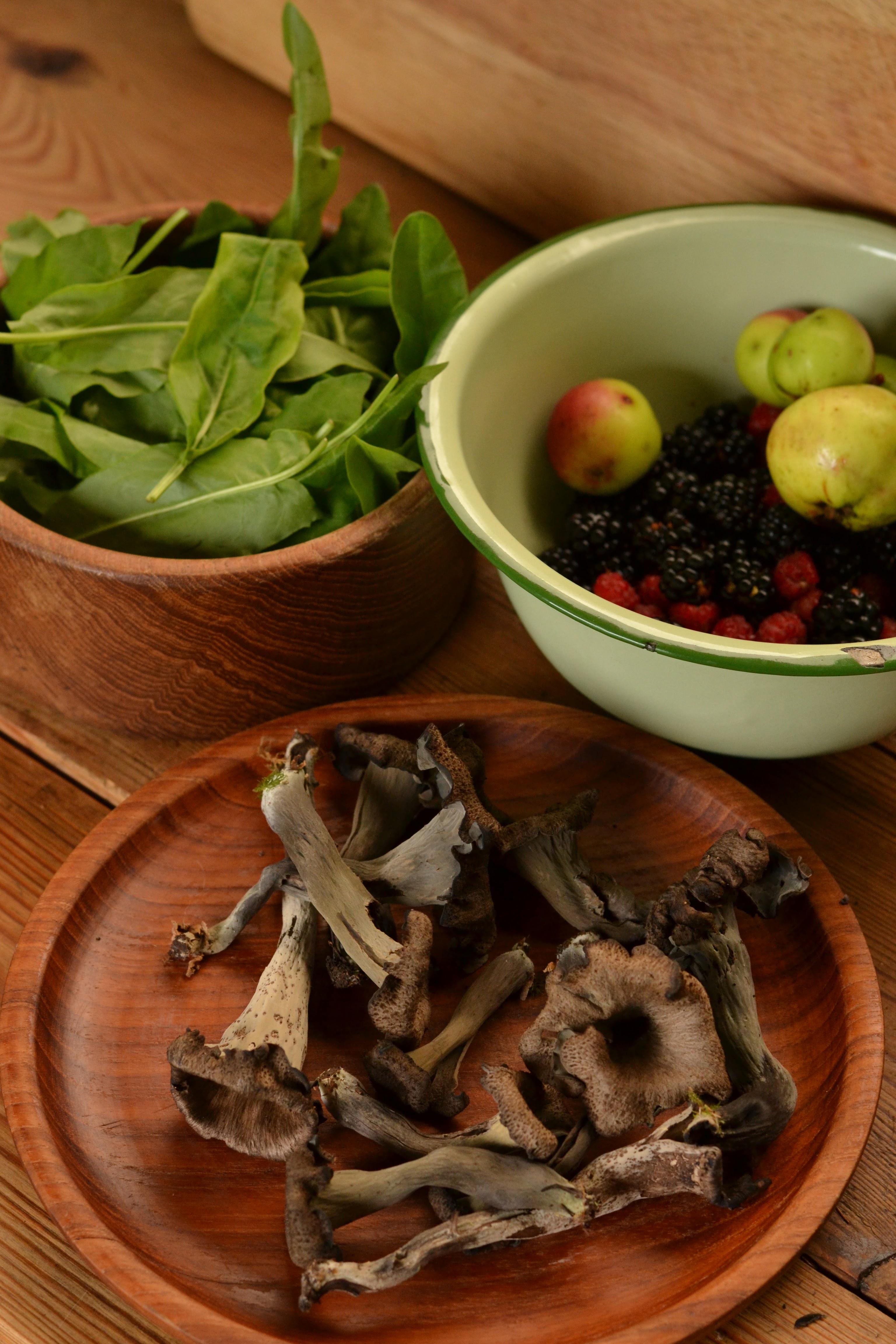

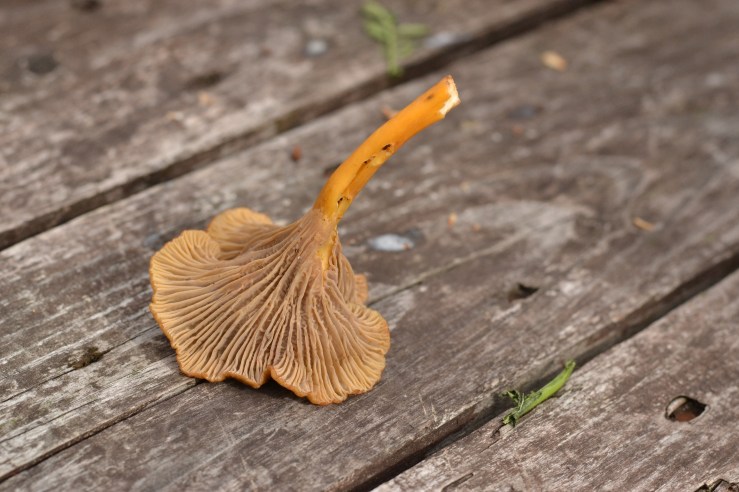
I was taking my basket for a walk in a deciduous woodland in the area of Newton Stewart, Dumfries and Galloway. Of course I had the hope that I might find some kind of fungi, but I wasn’t attached to the outcome. I realised I’d found myself on a deer trail. I could see the obvious signs of a slender path frequented by these beautiful creatures. Within a few heartbeats of this realisation I turned on the path and looked down at an antler on the ground. It was lying a few hoof steps away from a small shallow burn. I felt I was in deer territory and then like a sure sign the antler was there to confirm it. This was one of the unusual and unexpected gifts of taking my basket for a walk. I also happened to find some perfect hedgehog fungi, a small troop of chanterelles and I revisited a precious cluster of horn of plenty to find a couple of fresh ones. I returned with some dinner, and the antler. Even stranger, an hour or so later, in an obscure place in the woods, I met a person that I had met a few years earlier in Cumbria under very different circumstances. It was a serendipitous meeting; perhaps that antler acted like an antenna.
I also have an interest in medicinal and therapeutic properties of plants and wild food. I have gathered and made my own tinctures from hawthorn, lemon balm, bilberry, goldenrod, to name a few. It may be that these tinctures have no physiological effect, but it isn’t just about the physical effect and the resulting tincture, it’s about the finding, the gathering, the creating. This is all part of the medicinal properties for me. I believe that this is why GPs are now prescribing walks in nature, because nature is medicine, and it’s where we’re from and where we have become disconnected from. It might sound woo woo or like I’m a tree hugger, but for me being “in nature”- foraging for food, medicine, meaning- is not only healing, it is vital to what makes me human and animal. I feel connected in a way I never will from going into a supermarket or pharmacy.
On the rare occasion that I return from a walk with an empty basket, I have a calm mind and a satiated spirit. I cannot remember a time when I have returned without seeing or hearing something new; a bird call that I’ve never heard before, or a flower that has never bloomed before me until now. I may not have food for my belly but my soul is content. I return changed in some way.
 stravaig